

Over 2000 years ago there was an amazing discovery about triangles:
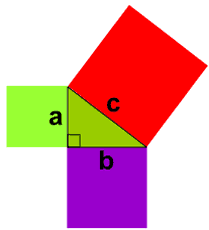
When a triangle has a right angle (90°) ...
... and squares are made on each
of the three sides, ...
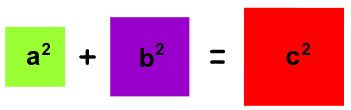
a2 + b2 = c2
- c is the longest side of the triangle
- a and b are the other two sides
Definition:
The longest side of the triangle is called the "hypotenuse", so the formal definition is:
In a right angled triangle:
the square of the hypotenuse is equal to
the sum of the squares of the other two sides.
the square of the hypotenuse is equal to
the sum of the squares of the other two sides.
Sure ... ?
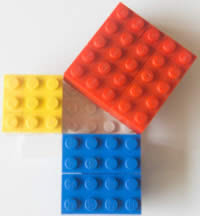
Let's see if it really works using an example.Example: A "3,4,5" triangle has a right angle in it.
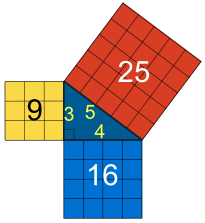 |
Let's check if the areas are the same:
32 + 42 = 52
Calculating this becomes:
9 + 16 = 25
It works ... like Magic! |
Why Is This Useful?
If we know the lengths of two sides of a right angled triangle, we can find the length of the third side. (But remember it only works on right angled triangles!)How Do I Use it?
Write it down as an equation: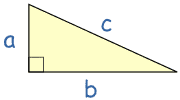 |
a2 + b2 = c2 |
Now you can use algebra to find any missing value, as in the following examples:
Example: Solve this triangle.
 |
a2 + b2 = c2
52 + 122 = c2
25 + 144 = c2
169 = c2
c2 = 169
c = √169
c = 13
|
Example: Solve this triangle.
 |
a2 + b2 = c2
92 + b2 = 152
81 + b2 = 225
Take 81 from both sides:
b2 = 144
b = √144
b = 12
|
Example: What is the diagonal distance across a square of size 1?
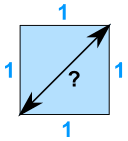 |
a2 + b2 = c2
12 + 12 = c2
1 + 1 = c2
2 = c2
c2 = 2
c = √2 = 1.4142...
|
Example: Does this triangle have a Right Angle?
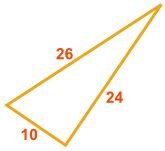 |
Does a2 + b2 = c2 ?
Yes, it does have a Right Angle!
|
Example: Does an 8, 15, 16 triangle have a Right Angle?
Does 82 + 152 = 162 ?
- 82 + 152 = 64 + 225 = 289,
- but 162 = 256
So, NO, it does not have a Right Angle
Example: Does this triangle have a Right Angle?
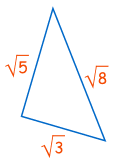 |
Does a2 + b2 = c2 ?
Does (√3)2 + (√5)2 = (√8)2 ?
Does 3 + 5 = 8 ?
Yes, it does!
So this is a right-angled triangle |
And You Can Prove The Theorem Yourself !
Get paper pen and scissors, then using the following animation as a guide:- Draw a right angled triangle on the paper, leaving plenty of space.
- Draw a square along the hypotenuse (the longest side)
- Draw the same sized square on the other side of the hypotenuse
- Draw lines as shown on the animation, like this:

- Cut out the shapes
- Arrange them so that you can prove that the big square has the same area as the two squares on the other sides.
Another, Amazingly Simple, Proof
Here is one of the oldest proofs that the square on the long side has the same area as the other squares.Watch the animation, and pay attention when the triangles start sliding around.
You may want to watch the animation a few times to understand what is happening.
The purple triangle is the important one.
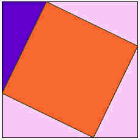 |
becomes | 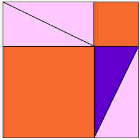 |
Here is a video showing that Pythagorean Relation is True!
If you found what you have read interesting, please do not hesitate to leave a comment!


unique
ReplyDeleteunique
ReplyDeletevery nice idea for proving
ReplyDelete